
Inside the ‘TA to BA’ Educator Fellowship: How One Rhode Island Initiative Is Elevating Experienced Paraprofessionals — and Creating a More Diverse Teacher Force
It was past 7 p.m. and everyone on the Zoom call had already worked jam-packed days in the classroom. But still, over 90 minutes into the session, the energy was palpable: cameras on, participants speaking without hesitation and listeners nodding vigorously.
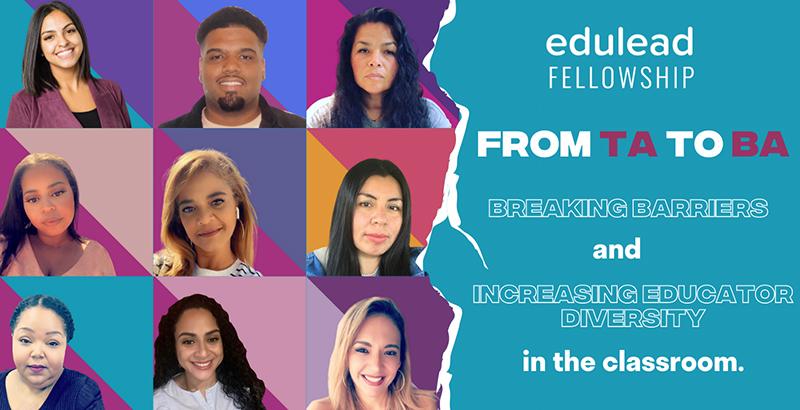
It was the weekly full-cohort meeting for the “TA to BA” fellowship, a group of 13 Rhode Island paraprofessionals studying to earn bachelor’s degrees and teaching certifications after spending years — or, in many cases, decades — in the classroom. Launched last year by a Rhode Island-based nonprofit called the Equity Institute, the program enrolls fellows in courses at College Unbound, a local higher education institution built for adult learners, providing scholarships to defray the costs.
This evening, discussion had landed on a topic near and dear to the hearts of many participants: racial diversity in the state’s teaching force.
Courtney Price, a teaching assistant in Providence, unmuted herself.
“We need to see more faces like the kids that we serve,” she said, reflecting on difficult conversations she’s had with the — mostly white — teachers at her school. “These are our babies.”
The chat box popped like popcorn with affirmations and agreement.
“Well said Ms. Courtney!”
“Very well said, Court.”
More than an observation shared in an online classroom, Price’s comment also spoke to the very reason each participant was on the call that evening. All people of color, and many fluent Spanish-speakers, the group is on a mission to increase the racial and linguistic diversity of the Rhode Island teaching force.
Despite research documenting the widespread benefits to students of all races from having teachers of color, there is a stark racial disconnect between the state’s teacher and student populations — an imbalance shared nationwide.
Eighty-nine percent of Rhode Island educators are white despite over 4 in 10 learners identifying as Black, Hispanic, Indigenous or Asian. In Providence, the largest district, 93 percent of students are kids of color while 79 percent of the teaching force remains white, the exact same share as the nation on the whole. Over half of Providence students come from homes where English is not the primary language.

It’s a completely different story, however, for paraprofessionals. Approximately 61 percent of non-teaching staff in Providence schools are people of color, according to information provided by the district, and teaching assistants comprise 31 percent of that pool. At all the schools Price has worked at in her 18 years in Providence, the paraprofessional staff has always been predominantly women of color while the teaching staff has always been predominantly white people, she told The 74 — a skew echoed by TAs working elsewhere.
In addition to impacts on students, there’s also a deep wage gap. After nearly two decades in her role, Price said she earns $18.65 an hour, but would be making three times as much per year if she had worked that span of time as a classroom teacher.
The Equity Institute designed their fellowship to help people like Price transform their deep classroom experience into certifications to become full-time classroom teachers. Their model draws on examples from Connecticut, Wisconsin and California. Next door in Massachusetts, an emergency licensure program created to prevent teacher shortages during the pandemic has propelled many paraprofessionals into lead teaching roles — and has successfully moved the needle on teacher diversity in the process.
Now, nearly a full school year into the Equity Institute’s program, with rave reviews from the inaugural class, all of whom are on a path toward graduation, and with already over 60 applications for next year, early signs show their Rhode Island effort is working.
As the pandemic causes upheavals in education that have many young professionals rethinking careers in teaching, programs like the Equity Institute’s TA to BA fellowship that harness the untapped potential of paraprofessionals may be a key to building a strengthened, more diverse educator workforce.